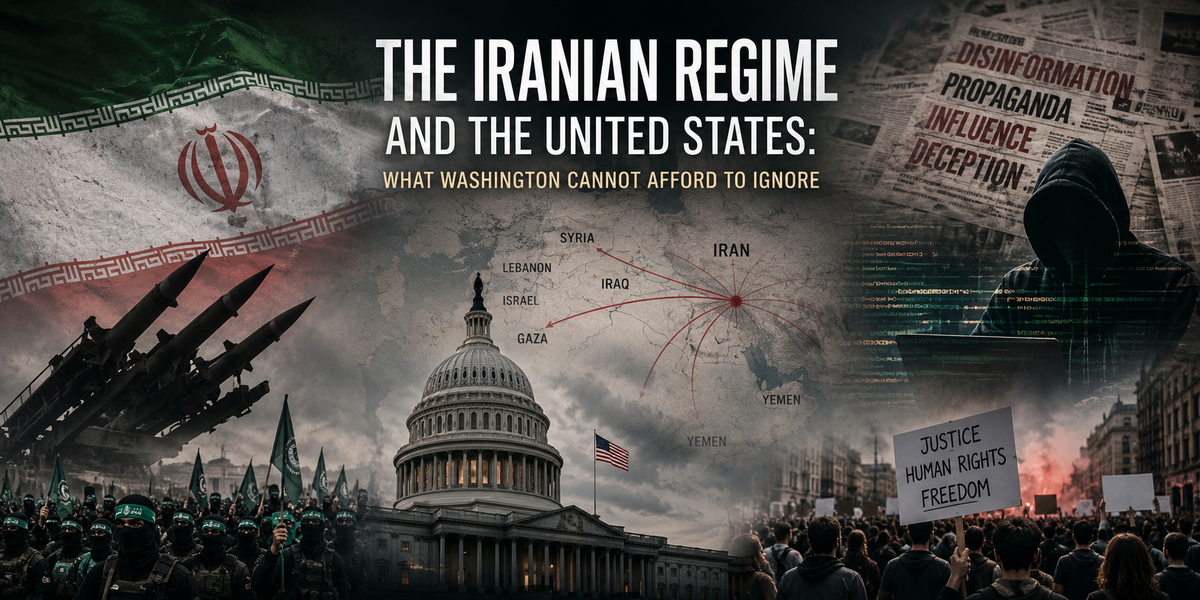
The Iranian Regime and the United States: What Washington Cannot Afford to Ignore
Why the Iranian regime’s proxy warfare, information operations, and support for armed groups should reshape how Washington approaches Tehran.
Executive Summary
The debate over U.S.-Iran relations is too often reduced to a familiar question: Can Washington negotiate with Tehran?
That may be the wrong place to begin.
Before asking what kind of agreement the United States might reach with the Iranian regime, policymakers should first examine the nature of the regime they are dealing with, how it projects power, and the distinction between what Tehran says at the negotiating table and what it enables beyond it.
This distinction became particularly important after the Hamas attack on Israel on October 7, 2023.
U.S. intelligence assessed that Iranian leaders did not orchestrate the attack and did not have foreknowledge of it. That assessment should be taken seriously. Evidence should not be stretched to support a conclusion it does not establish.
But the absence of demonstrated foreknowledge does not settle the larger question of responsibility.
For years, the Iranian regime supported Hamas and other armed organizations as part of a broader regional strategy. The relevant question is therefore not simply whether Tehran knew that Hamas would attack on October 7. It is also how Hamas developed the capabilities to conduct large-scale warfare, who helped sustain those capabilities, and why Iran’s role in building and supporting armed networks should matter when Washington evaluates Tehran as a diplomatic counterpart.
The same problem extends beyond conventional warfare.
U.S. intelligence has publicly warned that Iranian government actors have attempted to exploit divisions inside American society. In 2024, U.S. intelligence officials reported that actors tied to Iran’s government posed as activists online, sought to encourage protests over the Gaza war, and in some cases provided financial support to protesters. U.S. agencies subsequently described Iranian operations as attempts to stoke discord and exploit societal tensions.
This is where an uncomfortable comparison with Soviet and contemporary Russian information strategy becomes relevant.
The most effective influence operation does not necessarily ask Americans to support Iran. It may instead encourage Americans to distrust one another.
Taken together—proxy warfare, plausible deniability, domestic repression, information operations, and the strategic exploitation of existing grievances—these issues raise a question Washington should confront before treating another agreement as an end in itself:
Is the Iranian regime a credible negotiating partner, or is negotiation only one arena within a much broader struggle?
1. Foreknowledge Is Not the Same as Responsibility
Any serious discussion of Iran and October 7 must begin with an important fact.
The U.S. intelligence community assessed that Iranian leaders neither orchestrated nor had foreknowledge of the Hamas attack. The Office of the Director of National Intelligence made that assessment public in its 2024 Annual Threat Assessment.
That finding matters.
Criticism of the Iranian regime should not depend on claiming evidence that the public record does not establish. If Tehran did not know the date or operational details of the attack, it should acknowledge that distinction.
But that leads to a second question:
Why has the debate about Iranian responsibility so often stopped there?
Knowing the date of an operation is one form of involvement. Building, financing, training, arming, or sustaining an organization’s military capabilities represents another.
Hamas has long benefited from Iranian support. The U.S. National Counterterrorism Center continues to identify Iranian monetary support as one of Hamas’s sources of assistance.
The analytical mistake is therefore to treat these two propositions as mutually exclusive:
Iran may not have known the operational plan for October 7.
The Iranian regime nevertheless played a significant role in supporting the organization that carried it out.
Both can be true.
This distinction matters because Washington's strategic question is bigger than criminal-style attribution for a single attack. The United States must assess the system through which the Iranian regime has projected power across the Middle East.
October 7 cannot be understood entirely through what Tehran knew on October 6.
It must also be examined through what Tehran had been doing for years beforehand.
2. The Proxy System Is Not a Side Issue
Iran’s relationships with armed organizations are sometimes discussed as though they were peripheral complications surrounding an otherwise conventional state.
They are not.
They have been an important instrument of Iranian regional power.
Following October 7, the consequences became unmistakable. The U.S. intelligence community reported that Iran encouraged and enabled proxies and partners—including Hezbollah, Iran-backed groups in Iraq and Syria, and the Houthis in Yemen—to strike Israeli or American interests.
From October 2023 through February 2024, Iranian-aligned Iraqi Shia militants conducted more than 160 attacks against U.S. forces in Iraq and Syria. An attack on Tower 22 in Jordan in January 2024 killed three American soldiers and injured at least 40. U.S. intelligence also assessed that Iran-aligned groups later observed an Iranian-ordered pause in attacks—an important indication that Tehran could exert meaningful influence over at least some of these actors.
This illustrates the strategic value of a proxy network.
Tehran does not have to issue the operational order for every rocket, drone, kidnapping, or attack for the network to serve Iranian interests.
Indeed, some degree of autonomy can be useful.
It creates distance.
It complicates attribution.
It allows escalation to be calibrated.
And it creates what is commonly described as plausible deniability.
That does not mean every action by an Iran-aligned organization should automatically be attributed to Tehran. Such a conclusion would be analytically careless. Different groups have their own leaders, constituencies, incentives, and calculations. U.S. intelligence itself has recognized this complexity.
But acknowledging autonomy is not the same as pretending the network does not exist.
For American policymakers, the important question is how the system functions as a whole.
3. October 7 Changed the Question Washington Should Ask
For years, U.S. policy discussions have centered heavily on Iran’s nuclear program.
That concern is understandable. Nuclear proliferation carries enormous consequences.
But the nuclear question can become dangerously narrow when it causes Washington to evaluate Tehran primarily through uranium enrichment levels, centrifuges, inspections, sanctions relief, and negotiated limits.
The Iranian challenge is broader.
The regime has demonstrated its ability to project power through missiles, drones, cyber capabilities, regional armed organizations, and information operations. U.S. intelligence assessments have repeatedly identified these capabilities as threats to American interests and allies.
The events since October 7 should therefore change the conceptual framework.
The question should not simply be:
Can we reach an agreement with Tehran?
It should be:
What does an agreement accomplish if the broader strategy that threatens American interests continues outside the agreement?
This does not mean diplomacy has no purpose. Governments routinely negotiate with hostile governments. Diplomacy is not an endorsement of the other side's morality, and refusing every channel of communication can itself create security risks.
But negotiation and trust are different concepts.
A government can negotiate with an adversary while recognizing that the adversary is not a trustworthy partner.
That distinction should be central to American policy toward the Iranian regime.
4. Washington Cannot Separate Foreign Policy From the Nature of the Regime
There is another danger in discussing Iran purely as a geopolitical chess piece: the Iranian people disappear from the analysis.
They should not.
The Iranian people are not the Iranian regime.
This distinction is morally important and strategically necessary.
The Islamic Republic is an authoritarian theocratic system. U.S. human-rights reporting has documented severe restrictions on freedom of expression and the use of law to intimidate or prosecute people who criticize the government or raise human-rights concerns.
The regime’s treatment of its own population matters when assessing its political character.
An authoritarian government can still honor an international agreement. History offers plenty of examples of democracies negotiating with dictatorships when national interests required it.
But Washington should reject the opposite mistake as well: behaving as though domestic repression, external coercion, proxy warfare, and diplomatic behavior exist in completely separate compartments.
They can reflect the same political system.
This is particularly important when the United States talks about “Iran” as though 90 million people and the governing regime were interchangeable.
They are not.
Criticism should be directed precisely.
The subject of this report is the Iranian regime, not Iranian ethnicity, Iranian culture, Persian civilization, or the Iranian people.
Indeed, one of the greatest mistakes foreign observers can make is allowing opposition to Tehran’s government to become opposition to Iran itself.
5. Information Warfare: The Other Battlefield
The Iranian regime’s challenge to the United States is not confined to the Middle East.
It also reaches into the American information environment.
In July 2024, then-Director of National Intelligence Avril Haines issued an unusually direct public warning. U.S. intelligence had observed Iranian government actors exploiting protests over the Gaza war. Actors tied to Iran’s government had posed as activists online, sought to encourage protests, and even provided financial support to protesters. Haines simultaneously emphasized an essential distinction: Americans participating in protests were generally expressing their own views in good faith.
That qualification is crucial.
A legitimate protest does not become an Iranian operation merely because Tehran tries to exploit it.
A humanitarian concern does not become propaganda merely because a foreign government repeats it.
And disagreement with U.S. or Israeli policy is not evidence of foreign influence.
The more sophisticated problem is precisely the opposite.
Foreign influence works best when it attaches itself to something real.
6. The Soviet and Russian Parallel
This is where the Iranian approach deserves comparison with Soviet and later Russian information methods—not because the systems are identical, but because some of the strategic logic is strikingly similar.
Influence operations do not always need to invent grievances.
They can identify existing grievances and amplify them.
Racial tensions may be real.
Economic inequality may be real.
Civilian suffering in war may be real.
Distrust of political institutions may have legitimate causes.
The propagandist’s task is not necessarily to fabricate the underlying issue. It can be to manipulate its meaning, remove context, intensify emotion, and push opposing communities further apart.
Modern Russian influence operations provide a well-documented example of this logic. U.S. intelligence has described Russian objectives as including the erosion of trust in democratic institutions and the exacerbation of sociopolitical divisions inside the United States.
U.S. agencies have used remarkably similar language when discussing Iran.
In August 2024, ODNI, the FBI, and CISA stated that Iran sought to “stoke discord” and had a longstanding interest in exploiting societal tensions. The following month, the agencies said Iranian cyber actors had attempted to distribute stolen political campaign material, describing the activity as part of a broader effort to sow discord and influence the American electoral environment.
The comparison should therefore be made carefully.
Iran is not the Soviet Union. Iranian information operations are not simply copies of Russian operations. Their capabilities, ideology, institutions, strategic circumstances, and audiences differ.
But there is a shared principle worth understanding:
Propaganda's target does not have to be persuaded to love the propagandist.
Sometimes the objective is division.
An influence campaign does not need Americans to become supporters of the Iranian regime if it can make Americans more hostile toward other Americans.
That is a much more sophisticated—and potentially more effective—objective.
7. Sympathy Can Be Weaponized Without Being False
This creates one of the most difficult problems in modern information warfare.
Propaganda can look like empathy.
A message can focus on genuine victims. It can highlight genuine injustice. It can use authentic photographs, real testimony, or legitimate criticism.
The correct analytical question is therefore not:
“Is the underlying grievance real?”
It is:
“Who is amplifying this narrative, what has been omitted, and what behavior is the message designed to produce?”
This is also why governments and journalists must be extraordinarily cautious.
Labeling inconvenient criticism “Iranian propaganda” without evidence would itself damage democratic debate. It would delegitimize authentic voices and make serious investigation of actual foreign influence more difficult.
The evidentiary standard must remain high.
But the opposite extreme—assuming that foreign governments cannot exploit authentic grievances—is equally naïve.
The U.S. intelligence community’s findings regarding Iranian actors posing as activists demonstrate precisely why those two realities can coexist. Americans can protest in good faith while a foreign regime simultaneously attempts to manipulate the information environment surrounding those protests.
That is not a contradiction.
It is how modern influence operations work.
8. What This Means for Negotiating With the Iranian Regime
None of this produces the simple conclusion that the United States should never communicate with Tehran.
Communication between adversaries can prevent miscalculation. Negotiations can secure limited objectives. Even deeply hostile states sometimes need channels through which they can communicate.
But Washington should stop confusing negotiation with partnership.
A credible negotiating strategy must account for what happens outside the negotiating room.
If a regime simultaneously uses armed partners to pressure U.S. interests, maintains offensive missile and cyber capabilities, exploits plausible deniability, and conducts influence operations designed to aggravate divisions inside American society, those activities belong in assessing its strategic behavior.
The United States should therefore judge agreements by verifiable behavior, not conciliatory rhetoric.
Trust should never substitute for verification.
Diplomatic language should never obscure coercive activity.
And an agreement covering one category of weapons should not cause policymakers to ignore activities occurring elsewhere.
This is especially important because the regional balance has changed dramatically since October 7. Iran and its proxy network have suffered significant setbacks, and the 2026 U.S. intelligence assessment describes Iran’s strategic position as substantially degraded. But the same assessment says the regime remains intact and highlights continuing internal tensions.
A weakened regime is not necessarily a transformed regime.
That distinction matters.
9. America Needs a Wider Definition of Iranian Power
The central lesson is that Iranian power should not be measured only by conventional military strength.
It operates across several domains.
There is the state itself.
There are missiles, drones, cyber capabilities, and other military instruments.
There are armed partners and proxies.
There are economic and diplomatic tools.
And there is the information environment.
These instruments do not always operate under identical command structures. Nor should every action by every Iran-aligned actor be attributed automatically to Tehran.
But American strategy must be able to see the relationships among them.
Otherwise Washington risks negotiating with one part of the system while ignoring pressure generated by another.
The same analytical discipline should apply to October 7.
The available public U.S. intelligence assessment says Tehran did not orchestrate the attack or know about it beforehand. That should remain part of the factual record.
But it should not end the inquiry.
The broader question is how an organization such as Hamas accumulated the resources and capabilities necessary to wage war, what role Iranian support played in sustaining it, and how the Iranian regime has used relationships with armed groups to advance its regional objectives.
Foreknowledge is not the same as responsibility.
And responsibility is not limited to issuing the final order.
Conclusion: The Question Washington Cannot Avoid
For the United States, the challenge presented by the Iranian regime is ultimately a problem of strategic coherence.
Washington cannot evaluate Tehran only through the nuclear file while treating proxies, cyber operations, domestic repression, regional attacks, and foreign influence as unrelated subjects.
Nor should Americans allow legitimate humanitarian debates to blind them to the possibility that foreign governments deliberately exploit those debates.
At the same time, criticism of the Iranian regime must remain evidence-based.
That means acknowledging inconvenient facts.
If U.S. intelligence says Tehran did not know about October 7 beforehand, that assessment should not be erased simply because it complicates an argument.
If an Iran-aligned organization acts independently, acknowledge that independence.
If Americans protesting U.S. policy are acting sincerely, they should not be casually portrayed as agents of a foreign government.
Precision is not weakness.
It is what separates strategic analysis from propaganda.
That distinction matters most when analyzing a regime accused of using propaganda itself.
The United States can communicate with the Iranian regime when American interests require it. It can negotiate limited agreements when doing so produces verifiable security benefits.
But Washington should be much more cautious about treating negotiation as evidence that the underlying strategic conflict has been resolved—or treating Tehran as a conventional partner whose behavior can be understood solely through diplomatic statements.
The record since October 7 points in another direction.
Iranian-supported armed groups attacked U.S. and Israeli interests across the region. Iran itself demonstrated its ability and willingness to strike Israel directly. U.S. intelligence documented Iranian attempts to exploit political divisions inside the United States. The regime’s treatment of its own citizens also remains essential to understanding the political system Washington is dealing with.
The debate over Iran therefore needs to move beyond whether diplomacy is good or bad.
The more serious question is what diplomacy can realistically accomplish against a strategy that operates simultaneously through negotiation, coercion, armed networks, information operations, and plausible deniability.
October 7 should have taught Washington one lesson above all:
Do not confuse the absence of evidence that Tehran ordered a particular attack with the absence of a larger Iranian strategy.
And do not judge the Iranian regime only by what it promises across a negotiating table.
Judge it by the system it has built, the behavior it enables, the methods it employs, and the actions it takes when it believes those actions will advance its interests.
Only then can the United States decide when negotiation serves American security—and when negotiation risks becoming a substitute for strategy.


Comments ()