Japan’s Security Reckoning 2026: Russia, Deterrence and the Future of Article 9
Putin’s Etorofu visit exposes a deeper shift in Japan–Russia relations. This strategic analysis examines Article 9, deterrence, North Korea and the future of Japan’s security.
Strategic Analysis | Indo-Pacific Dispatch
Russia’s challenge to Japan is no longer confined to a territorial dispute inherited from the end of the Second World War.
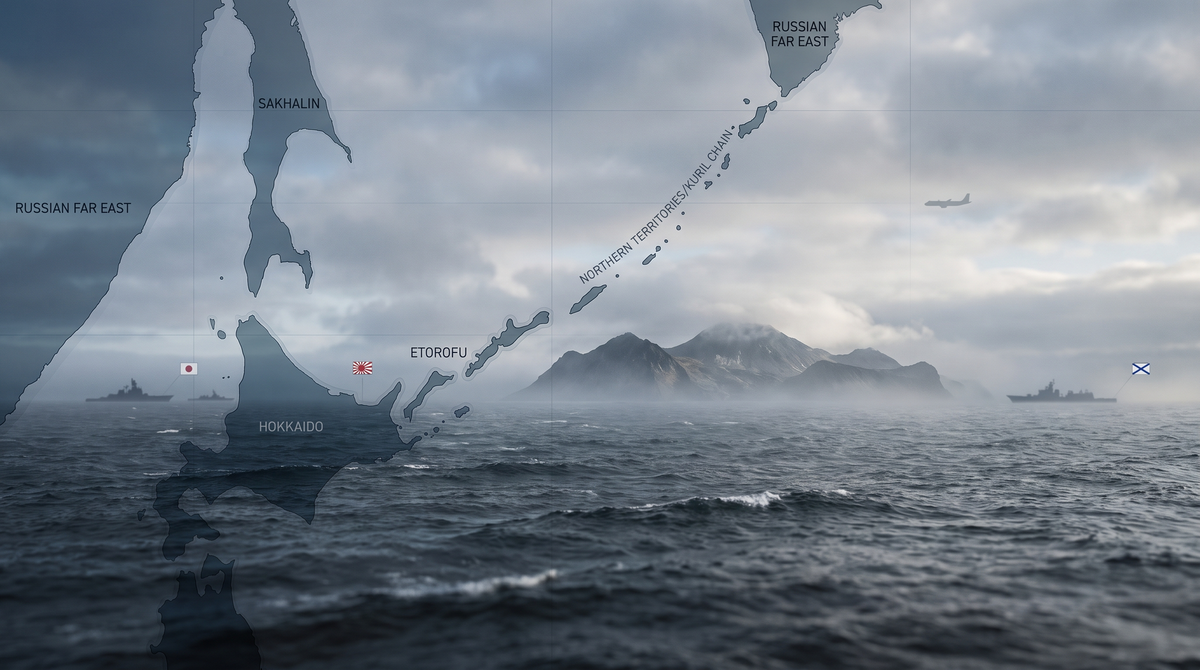
President Vladimir Putin’s visit to Etorofu Island—known as Iturup in Russia—has reopened one of the most sensitive questions in Japan–Russia relations: the unresolved Northern Territories dispute.
But the strategic implications now extend considerably further.
The incident comes as Japan reassesses deterrence, the future of Article 9, the constitutional status of the Self-Defense Forces and the credibility of the security architecture that has protected the country throughout the postwar era.
The question is no longer simply who controls four disputed islands.
It is whether Japan’s existing security framework can preserve peace in an environment increasingly shaped by Russian military power, Russia–North Korea cooperation, and renewed great-power competition.
Key Assessment
Putin’s Etorofu visit should be understood not merely as another episode in the Northern Territories dispute, but as a deliberate assertion of Russian authority and a test of Japanese strategic resolve.
Japan was right to respond firmly.
The larger challenge, however, extends beyond the territorial dispute itself. Russia’s military posture in Northeast Asia, its deepening relationship with North Korea and the deterioration of the post-Cold War security order are forcing Japan to confront a more fundamental question:
Can a constitutional and defense architecture designed for postwar Japan provide credible deterrence in the strategic environment of the 2020s?
That question reaches directly into the debate over Article 9, the future status of the Self-Defense Forces, Japan’s responsibilities within the US–Japan alliance and ultimately Japan’s role in an international security system whose most important institutions still reflect the distribution of power that existed in 1945.
Putin’s Etorofu Visit and the Northern Territories Dispute
On 13 August 2026, Russian President Vladimir Putin visited Etorofu Island, one of the four islands Japan identifies as its Northern Territories.
The Kremlin publicly documented the visit.
Tokyo responded immediately.
Prime Minister Sanae Takaichi rejected the visit as unacceptable, while Japan’s Ministry of Foreign Affairs summoned the Russian ambassador and lodged a strong protest.
Japan’s position on the Northern Territories remains explicit: the four islands are inherent parts of Japanese territory, and the territorial issue should be resolved through negotiations with Russia.
The incident could therefore be treated as another confrontation in a territorial dispute stretching back eight decades.
That interpretation would underestimate its significance.
Territorial disputes are rarely only about territory.
They are also about authority.
They are about presence.
And they are about whether one state can repeatedly demonstrate control until that control becomes increasingly difficult for another state to contest.
Russia currently administers Etorofu.
Japan claims sovereignty over it.
A visit by the Russian president therefore carries political meaning beyond the physical presence of one individual on disputed territory.
Presidential visits create political facts.
They demonstrate administration.
They communicate confidence.
And they test the response of the state challenging that authority.
Moscow could reasonably have anticipated that Tokyo would protest Putin’s presence on Etorofu.
The visit nevertheless went ahead.
That makes it difficult to interpret purely as routine domestic travel.
It was also strategic signaling.
Japan therefore needed to answer that signal.
Why Japan’s Response to Russia Matters for Deterrence
Deterrence is not constructed only through missiles, warships or military budgets.
It is also constructed through political consistency.
A government that identifies territory as sovereign but becomes reluctant to respond when another state publicly asserts authority over that territory risks creating uncertainty about its own resolve.
That does not mean military escalation is required.
Quite the opposite.
Diplomatic protest, political signaling and military deterrence occupy different points on the spectrum of statecraft.
Japan’s response to Putin’s Etorofu visit demonstrated that distinction.
Tokyo did not need to threaten military action to make its position clear.
It needed to show that Japanese silence would not politically normalize the Russian action.
The objective was not escalation.
It was clarity.
And strategic clarity is itself part of deterrence.
This distinction will become increasingly important for Japan as it confronts security challenges that may deliberately remain below the threshold of armed conflict.
Why Russia Has Changed Japan’s Security Environment
For much of the post-Cold War era, Japan attempted to separate territorial negotiations with Moscow from the wider strategic relationship.
Economic engagement and diplomatic dialogue were expected, at various points, to create conditions under which progress over the Northern Territories might eventually become possible.
That approach reflected a broader assumption extending far beyond Japan.
Russia after the collapse of the Soviet Union would remain difficult, but potentially integrable into a European and international order increasingly governed by institutions, economic interdependence, and negotiated rules.
The full-scale Russian invasion of Ukraine in 2022 exposed the limits of that assumption.
It did not suddenly create geopolitical competition between Russia and the West.
It revealed how much of that competition had survived beneath the optimism of the post-Cold War period.
The Soviet Union disappeared.
The Cold War ended in its institutional and ideological form.
But the geopolitical logic of power did not disappear.
For Japan, that distinction matters.
Russia is not merely the state controlling islands Tokyo claims.
It is a nuclear-armed military power operating immediately adjacent to Japan’s northern approaches.
Japan’s own defense assessments describe the country as confronting one of the most severe and complex security environments of the postwar era.
Russian military activity must therefore be understood within a larger strategic picture that includes the war in Ukraine, Moscow’s relationship with Beijing and the accelerating military relationship between Russia and North Korea.
The Northern Territories dispute has not disappeared.
Its strategic context has changed.
The map remains familiar.
The map's meaning does not.
Russia–North Korea Military Cooperation and the Threat to Japan
The deepening military relationship between Russia and North Korea matters for Japanese security.
Japan, the United States and South Korea increasingly treat Russia–North Korea military cooperation not as an isolated bilateral development, but as a wider regional security concern.
North Korea already possesses ballistic missile systems capable of threatening Japanese territory and continues to develop nuclear and missile capabilities.
The strategic risk is therefore not hypothetical.
The question is what happens if cooperation with Russia accelerates North Korea’s ability to improve those systems.
Russia has accumulated extensive battlefield experience in missile employment, electronic warfare, targeting, air defense penetration and high-intensity military operations during the war in Ukraine.
North Korea has developed an increasingly sophisticated missile and weapons program of its own.
The convergence of these two military systems deserves close scrutiny.
The critical issue is not simply whether Moscow transfers weapons to Pyongyang or Pyongyang supplies weapons to Moscow.
It is whether knowledge moves with them.
Technical expertise matters.
Operational experience matters.
Targeting knowledge matters.
Battlefield feedback matters.
If Russian assistance or experience contributes to improvements in North Korean missile accuracy, survivability, targeting, electronic warfare or operational planning, the consequences will not remain confined to Ukraine or the Korean Peninsula.
They will directly affect Japan.
This is why Russia should increasingly be understood as a potential threat multiplier in Northeast Asia.
Russia is to Japan’s north.
North Korea lies across the Sea of Japan.
China is increasingly active in the East China Sea and the wider Western Pacific.
These states have different interests, capabilities, and relationships with Japan.
They should not be artificially reduced to a single bloc.
But their growing strategic interaction should not be ignored.
Japan's security challenge is no longer defined solely by each country's independent capabilities.
It is increasingly shaped by what those countries can provide one another.
The implications reach directly into Japan’s debate over deterrence—and ultimately into the constitutional framework governing Japanese defense.