
Riots in France Isn't A Protest
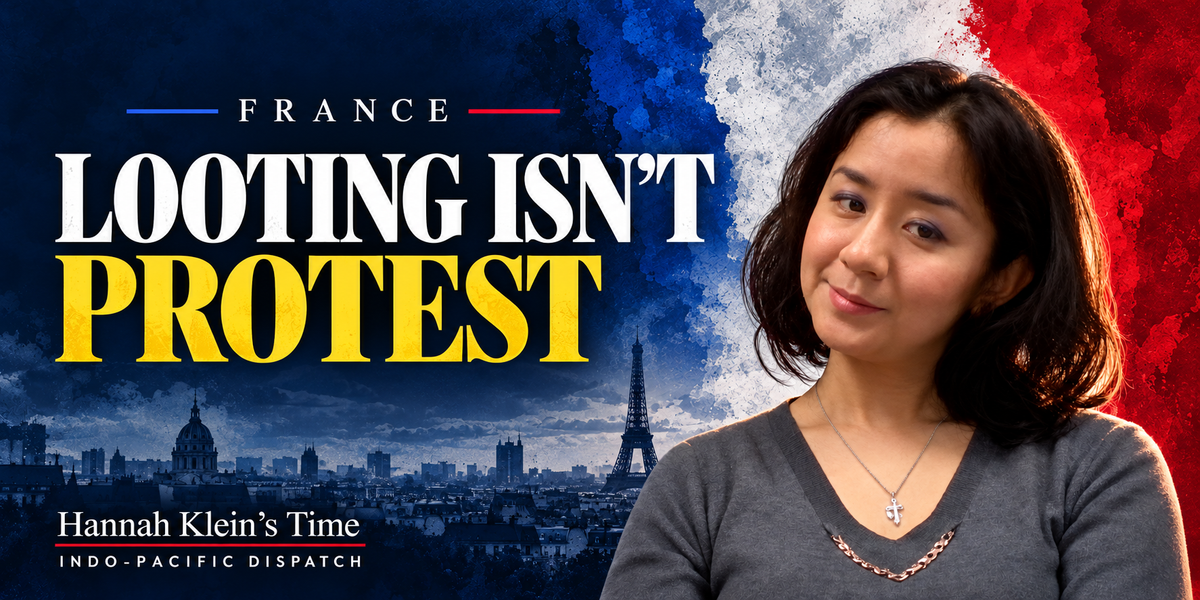
Peaceful advocacy deserves protection. Looting, intimidation, and destruction demand accountability—whatever political cause is invoked.
By Hannah Klein
The Indo-Pacific Dispatch
**This podcast is audible on Apple Podcast and Spotify.
Apple Podcast
Spotify
Looting is not a legitimate expression of political disagreement. Destroying someone’s shop does not advance justice. Threatening people does not strengthen an argument. A political slogan cannot absolve an individual of responsibility for criminal conduct.
In my latest episode of Hannah Klein’s Time: Indo-Pacific Dispatch, I discuss France’s unrest and my concerns about radicalization within parts of the pro-Palestinian movement. My position begins with a straightforward principle: the right to demonstrate does not include a right to harm others.
That principle should apply consistently, regardless of the flags people carry or the causes they support.
The People Who Pay for Destruction
Behind a damaged storefront may be years of work, family savings, and employees who depend on the business for their income. A shop owner does not become an acceptable target because a demonstrator is angry with the government or objects to a conflict overseas.
The consequences of destruction extend beyond property. People can lose their sense of security in the neighborhoods where they live and work. Businesses may face interrupted operations, and employees may face uncertainty about their next paycheck.
These people deserve a place in the discussion. Their losses should never be treated as an incidental cost of someone else’s political expression.
Understanding why people are angry can help explain a protest. It does not excuse what individuals choose to do during it.
My Concern About Radicalization
My concern is with the point at which political commitment becomes permission to intimidate, threaten, or excuse violence.
Criticism of Israeli government policy is legitimate political expression. Advocacy for Palestinian rights is also legitimate. Neither, by itself, establishes extremism.
The conduct and language of particular participants must be examined carefully. Threats, the glorification of attacks on civilians, and hostility toward Jewish people require scrutiny wherever they occur. Jewish individuals and institutions must never be treated as substitutes for the Israeli government or held collectively responsible for its decisions.
Equally, responsibility for violence must be established through evidence. A flag visible in a crowd does not prove who committed a crime. Allegations about an organization’s involvement require more than association or assumption.
Precision strengthens criticism. It allows us to identify harmful behavior without assigning guilt to everyone who shares a political position.
Movements Have Responsibilities
Organizers cannot necessarily control every person who appears at a large demonstration. They can, however, establish clear expectations and respond firmly when those expectations are violated.
A credible movement should reject threats, antisemitism, attacks on civilians, and the destruction of property. Its leaders should be willing to condemn wrongdoing by people claiming to support the same cause.
That condemnation should be direct. It should not depend on whether acknowledging the misconduct is politically convenient.
The same standard applies across political movements. Shared convictions do not create an exemption from accountability.
Authorities Must Protect the Public
Governments have a responsibility to protect peaceful assembly and freedom of expression. They also have a responsibility to protect residents, businesses, places of worship, and public institutions.
Meeting those obligations requires lawful policing, careful decisions, and fair investigations. Allegations of misconduct by officers must receive serious scrutiny, just as allegations against demonstrators must.
Arrests should not be confused with convictions. Accountability requires evidence, due process, and responsibility assigned to the people whose actions can be established.
Public confidence depends on that consistency.
A Cause Must Answer for Its Methods
For me, the central question is whether political conviction is being used to excuse behavior that would otherwise be condemned without hesitation.
Compassion for civilians should deepen our respect for human life. A commitment to justice should strengthen our willingness to apply standards fairly.
When advocacy makes room for intimidation or destruction, we should challenge its methods.
My position is clear: protect peaceful expression, investigate wrongdoing fairly, and hold those responsible for violence accountable.
Looting does not become acceptable because someone attaches a political message to it.
Listen to the accompanying episode of Hannah Klein’s Time: Indo-Pacific Dispatch for my commentary on protest, radicalization, and public accountability.
Comments ()