Japan’s New Takaichi Cabinet: Why the Prime Minister Deserves More Credit
Prime Minister Sanae Takaichi’s new Cabinet is more than a reshuffle. It offers Japan an opportunity to strengthen economic resilience, advance constitutional reform and restore confidence in its future. I explain why she deserves credit—and what she must deliver.
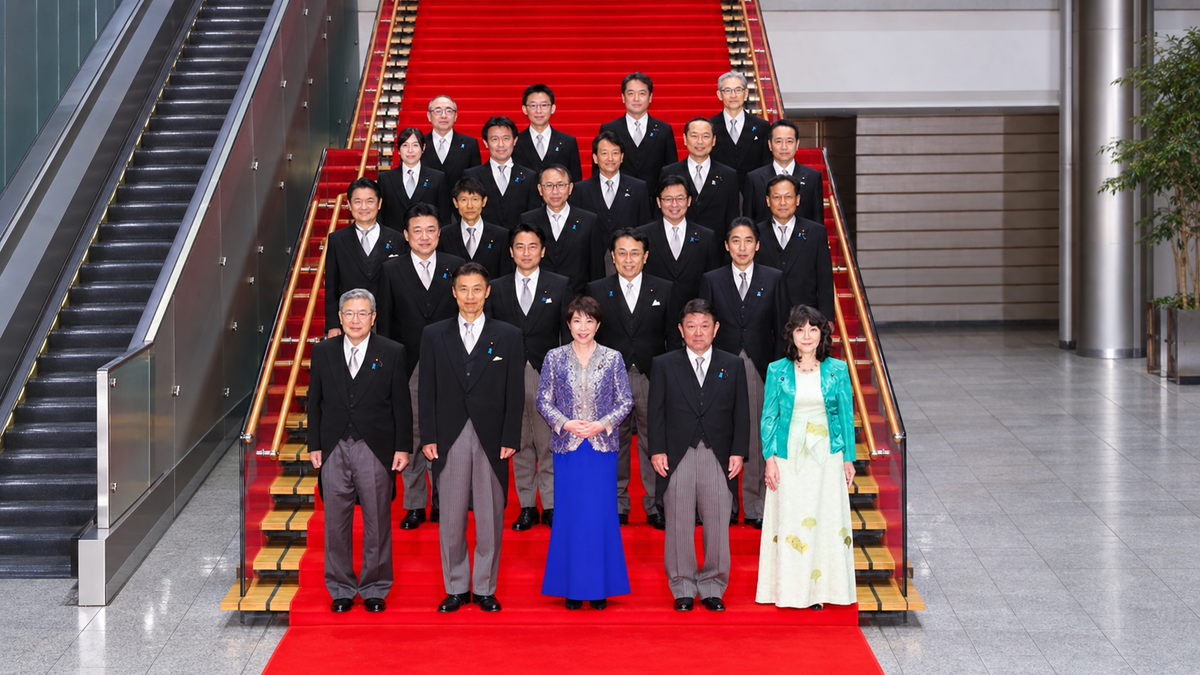
Sanae Takaichi’s first Cabinet reshuffle is less a dramatic reset than a deliberate statement of continuity. In an era of economic pressure and deepening strategic risk, that may be precisely the point.
On September 17, 2026, Prime Minister Sanae Takaichi reshuffled her Cabinet for the first time since taking office. Ten of the 18 ministers were replaced, yet the officials responsible for Japan’s most consequential external and economic relationships remained in place.
Foreign Minister Toshimitsu Motegi, Defense Minister Shinjiro Koizumi, Finance Minister Satsuki Katayama, Economy, Trade and Industry Minister Ryosei Akazawa, and Economic and Fiscal Policy Minister Minoru Kiuchi kept their posts. Chief Cabinet Secretary Minoru Kihara also stayed. Meanwhile, Hiroshi Nakatsuka of the Japan Innovation Party entered the Cabinet, marking the coalition partner’s first Cabinet representation since its partnership with the Liberal Democratic Party began.
That combination—substantial personnel turnover alongside continuity in strategic ministries—is the reshuffle's central message.
Takaichi is not attempting to convince the public that Japan can solve its problems merely by changing faces. Nor is she discarding the people already managing relations with Washington, defense modernization, trade negotiations, the yen, and Japan’s increasingly difficult fiscal choices. Instead, she is trying to refresh her administration while preserving a functioning core.
I believe she deserves credit for that decision. More importantly, I see this Cabinet as the beginning of a larger test of her premiership.
I expect Takaichi to lead Japan toward greater economic resilience and use her time as prime minister to advance a serious democratic case for constitutional reform, including amending Article 9. These objectives belong together. Japan cannot exercise strategic responsibility abroad without a productive, technologically capable and financially sustainable economy at home. Nor should its defense institutions remain indefinitely under constitutional ambiguity as the regional security environment grows more dangerous.
This does not mean abandoning Japan’s commitment to peace. It means creating a constitutional framework that clearly recognizes the Self-Defense Forces, strengthens democratic accountability, and allows Japan to defend its people and contribute credibly to regional deterrence.
This is not an argument that every appointment is beyond criticism, or that the government has already proved its economic program will work. It has not. It is an argument that political leadership should be judged not only by popularity, symbolism or immediate market reaction, but by whether it recognizes the scale of the country’s challenges and constructs a government capable of confronting them.
Japan now faces several crises at once: persistent pressure on household living standards, a weak yen, rising interest rates, enormous public debt, a shrinking population and an increasingly dangerous regional security environment. A serious Cabinet must therefore do more than distribute party posts. It must connect economic resilience, national defense, technological strength and alliance management.
The new Takaichi Cabinet at least reflects that strategic understanding.
Continuity is not complacency
Cabinet reshuffles in Japan are often treated as tools to boost approval ratings or balance party factions. Those considerations are certainly present here. But reducing this reshuffle to political management misses its more important feature.
By retaining Motegi, Koizumi, Katayama, Akazawa and Kiuchi, Takaichi has protected continuity in the policy areas where disruption would be most costly.
Japan must manage a demanding but indispensable alliance with the United States. It must review its security and defense strategy amid threats from China, North Korea and Russia. It must navigate trade and investment negotiations with Washington. It must respond to inflation and currency weakness without letting concerns over government borrowing spiral.
Experience and established relationships matter in each of these fields. Constantly changing the officials responsible for them would not demonstrate boldness; it could weaken Japan’s ability to negotiate and execute policy.
The retention of senior ministers is therefore not evidence that the reshuffle lacks ambition. It is evidence that Takaichi understands which parts of the government require stability.