
From Yugoslavia’s Breakup to Russia’s War Against Ukraine: A Conversation with Matej Markic
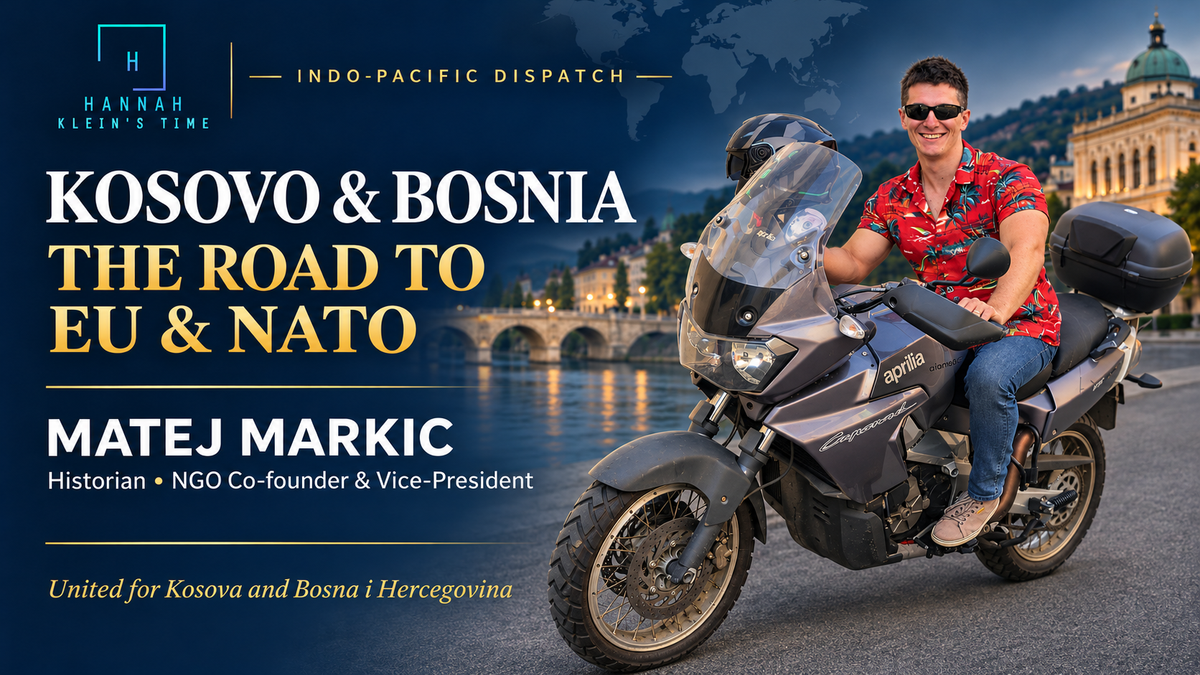
Historian Matej Markic joins Hannah Klein to discuss Yugoslavia’s breakup, Russia’s war against Ukraine, and the future of European security. They explore EU and NATO membership prospects for Kosovo and Bosnia and Herzegovina, and his research on antisemitism in Slovenian history.
What can the breakup of Yugoslavia teach us about European security as Russia wages war against Ukraine? Where do the parallels end?
In this episode of Hannah Klein’s Time: Indo-Pacific Dispatch, I speak with historian Matej Markic about why Yugoslavia fell apart, what its history can tell us about sovereignty and European defense, and why he advocates for Kosovo and Bosnia and Herzegovina to join the European Union and NATO.
Spotify
Apple Podcasts
Why did Yugoslavia fall apart?
I wanted to begin with a question that can get lost when we focus on the wars themselves. How was Yugoslavia supposed to work, and what happened when the people and republics within it disagreed about who should hold power?
Matej discusses Yugoslavia's political structure and the tensions that accompanied the concentration of power in Belgrade. That raises a broader question about political representation. When communities feel that decisions about their future are being made without them, what room is left to resolve those disputes within a shared state?
What the comparison with Ukraine can tell us
The breakup of a multinational federation and Russia’s war against a sovereign neighbor have different origins. Placing them side by side raises a question about Europe’s response in each case. What can diplomacy achieve once fighting has begun, and what role should military preparedness play?
We also discuss pacifism and European defense. I wanted to explore the practical choices behind that debate. What obligations do European governments have when another country’s sovereignty is threatened? How should they weigh the risks of military involvement against the consequences of a limited response?
Kosovo and Bosnia and Herzegovina’s place in Europe
Matej brings an advocate’s perspective to these questions. He is the co-founder and vice-president of United for Kosova and Bosna i Hercegovina, a Brussels-based NGO that advocates for both countries to join the EU and NATO.
Those institutions address different needs. EU membership concerns political and economic integration, while NATO membership concerns collective defense. Our conversation looks at why Matej sees a place for both in the Western Balkans’ future and what closer ties to each could mean for people in Kosovo and Bosnia and Herzegovina.
Studying antisemitism in Slovenian history
Matej’s research also examines antisemitism in Slovenian history from the nineteenth century onward. I was interested in what studying one place closely can reveal about how anti-Jewish prejudice spread and changed over time.
That research brings a different set of questions to the episode. How do historians trace the circulation of prejudices across generations? What can local history reveal that a broad account of European antisemitism might miss?
If you listen to the episode, I’d be interested to hear which part of the conversation stayed with you, whether it was Yugoslavia’s breakup, the debate over European defense, or Matej’s research into antisemitism.
If you value interviews like this, please consider becoming a paid subscriber to The Indo-Pacific Dispatch. Your subscription supports the research, preparation, and production behind this independent podcast.


Comments ()