Indo-Pacific Maritime Security Analysis 2026: China’s New Playbook
China’s maritime strategy is increasingly testing control without open conflict. From the Taiwan Strait to the First Island Chain, we examine the gray-zone tactics reshaping Indo-Pacific security in 2026—and the critical indicators policymakers should watch next.
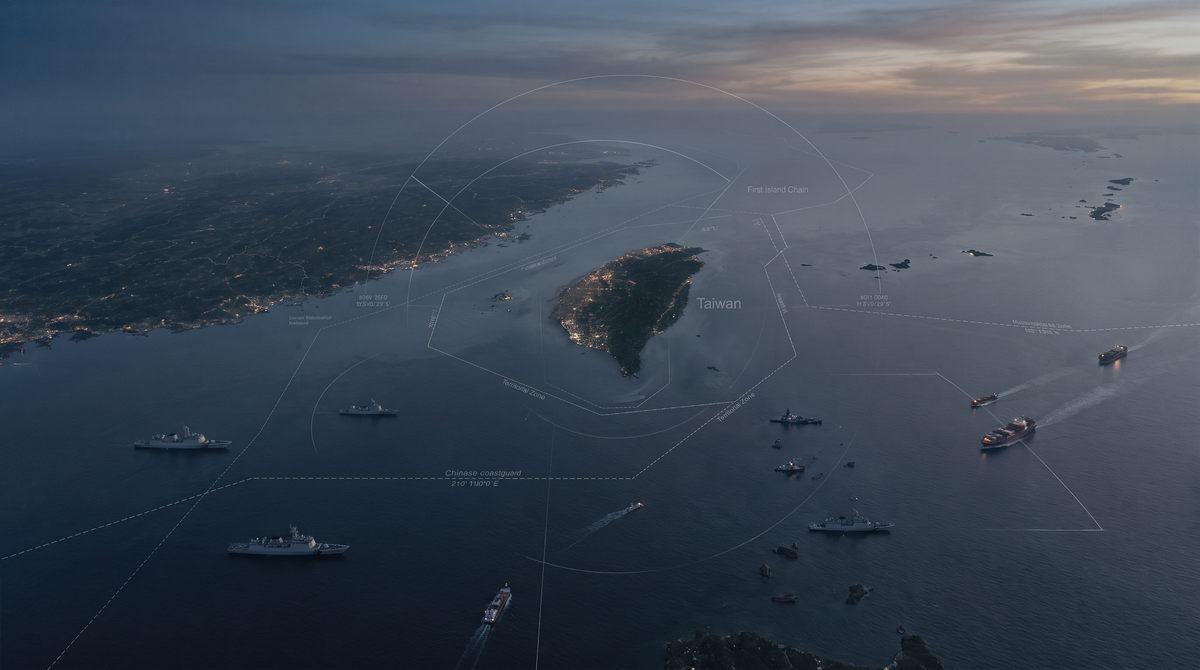
The most consequential maritime contest in the Indo-Pacific may not begin with a naval battle. It may begin with an assertion of authority that gradually becomes difficult to reverse.
The Indo-Pacific maritime security environment in 2026 is entering a more complex phase.
For years, the strategic debate has centered on familiar measures of military power: the size of China's navy, American carrier deployments, missile inventories, Taiwan's defensive capabilities and the expanding security relationships linking the United States with Japan, the Philippines and other regional partners.
Those measures remain important. But they can obscure a subtler contest now taking shape across the region.
The increasingly consequential question is not simply who can dominate the seas in wartime, but who can establish authority over them before a war begins.
Recent developments around Taiwan illustrate the problem.
As Typhoon Dolphin approached the region in August, Chinese authorities attempted to impose traffic-control measures on vessels transiting the Taiwan Strait. Taiwan rejected the directive and instructed ships to disregard Chinese broadcasts, treating the measure as an unacceptable assertion of jurisdiction rather than an ordinary maritime-safety precaution.
The episode attracted far less international attention than a major People's Liberation Army exercise would have.
Strategically, however, that may be precisely why it matters.
China does not necessarily have to close the Taiwan Strait to begin changing expectations about who has the authority to regulate it. It can attempt to establish that authority incrementally—through maritime administration, coast guard operations, exercises, safety directives, and increasingly routine demonstrations of jurisdiction.
That distinction lies at the center of Indo-Pacific maritime security analysis in 2026.
Maritime Security Has Entered a New Phase
Traditional naval deterrence asks a relatively straightforward question: if a conflict begins, can one military prevent another from achieving its objectives?
Gray-zone maritime competition asks a harder question.
What happens when strategic objectives are pursued through activities that do not clearly constitute military aggression?
Coast guards patrol disputed waters. Maritime authorities issue navigation notices. Research vessels conduct surveys. Civilian and paramilitary vessels operate alongside military forces. Governments invoke domestic regulations to justify actions contested by neighboring states.
Individually, such incidents may appear manageable.
Collectively, they can alter the strategic environment.
The danger, then, is not only escalation. It is normalization.
A state that repeatedly exercises authority in contested waters may gradually make that presence appear routine. Challenging it then becomes politically and militarily more difficult because the party seeking to restore the previous situation can itself appear to be escalating.
This is particularly significant around Taiwan.
The Taiwan Strait Is Becoming a Test of Maritime Authority
The dispute during Typhoon Dolphin illustrates how apparently technical maritime measures can carry strategic implications.
Beijing's position regarding Taiwan is well known. China claims sovereignty over the island and rejects interpretations of the Taiwan Strait that undermine that claim. Taiwan, meanwhile, maintains its own government, armed forces and coast guard and rejects Beijing's authority over it.
Against that background, an instruction to international shipping cannot be viewed solely as a weather precaution.
The underlying issue is jurisdiction.
Who possesses the legitimate authority to tell vessels how to behave in the Taiwan Strait?
That question matters because future coercion against Taiwan would not necessarily begin with an invasion.
Analysts have long examined blockade and quarantine scenarios in which Beijing could attempt to regulate access to Taiwan without immediately initiating the kind of large-scale attack that would make the international response comparatively straightforward.
A quarantine would create a much more ambiguous problem.
China could present inspections, exclusion areas or navigation restrictions as law-enforcement measures. Taiwan could regard the same actions as acts of coercion. Commercial shipping companies and insurers would then have to decide whose instructions to follow while foreign governments confronted the question of when maritime enforcement becomes military aggression.
This makes apparently minor jurisdictional precedents strategically significant.
The objective need not be immediate control.
It may be to make Chinese authority progressively less unusual.
Gray-Zone Competition Is Moving Beyond Taiwan's Western Approaches
Geography also indicates how the maritime environment is changing.
Taiwan's western coast faces the Taiwan Strait and mainland China. Consequently, much discussion of a potential conflict has traditionally concentrated on the strait itself.
Taiwan's eastern approaches present a different strategic problem.
The waters east of the island open into the Pacific. In a conflict, they could be critical to sustaining external access to Taiwan and would be highly important for naval and submarine operations.
Chinese activity in these waters therefore deserves particular scrutiny.
This week, Taiwan criticized a Chinese naval exercise with Indonesia near its eastern waters. Indonesia described the activity as a conventional passing exercise rather than a warfighting drill.
That distinction matters.
Indonesia should not automatically be interpreted as aligning itself with China's position on Taiwan. Jakarta has its own tradition of strategic autonomy, and Southeast Asian governments have repeatedly demonstrated that military engagement with Beijing can coexist with resistance to Chinese maritime claims.
The more important question concerns China itself.
Is Beijing attempting to make a wider Chinese operational presence around Taiwan increasingly routine?
If so, the strategic geography of a Taiwan contingency is changing.
Coast-guard patrols, naval transits and exercises need not individually indicate preparation for conflict. Their cumulative effect, however, may establish patterns of presence that could matter during a future crisis.
Taiwan Is Preparing for More Than an Amphibious Invasion
Taiwan's annual Han Kuang exercises provide the other side of the equation.
The 2026 drills have tested not only conventional military responses but the resilience of the broader society. Exercises have included coastal strike operations, anti-blockade scenarios and deliberate restrictions on mobile internet designed to simulate communications disruption.
Taiwan has also been examining how it could sustain industrial capacity if an adversary attacked key facilities.
This represents an important evolution in deterrence thinking.
The central question is no longer simply whether Taiwan's armed forces could defeat an amphibious landing.
It is whether Taiwan could continue functioning under prolonged coercion.
A blockade, communications disruption, cyber operations, maritime inspections and economic pressure could test Taiwan's resilience without producing the clear opening moment traditionally associated with war.
That ambiguity could be one of Beijing's greatest strategic advantages.
And it explains why maritime security must increasingly be analyzed alongside economic resilience, telecommunications, coast-guard capacity, and civilian preparedness.