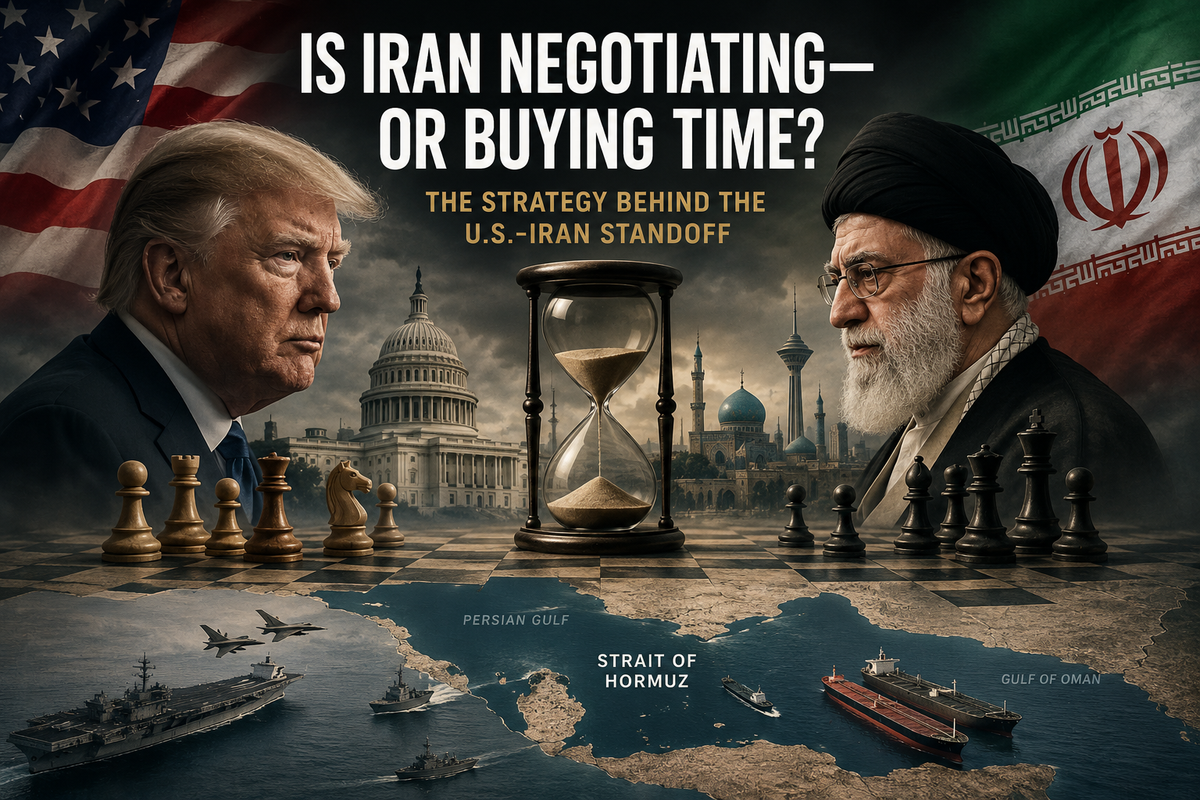
Is Iran Negotiating—or Buying Time? The Strategy Behind the U.S.-Iran Standoff
Is Iran using negotiations with the United States to buy time? An analysis of Tehran’s strategy, regime survival, military recovery, Hormuz, and Washington’s dilemma.
By Hannah Klein
Executive Summary
The central question surrounding the U.S.-Iran confrontation may no longer be whether Washington and Tehran can reach an agreement.
It may be what Iran gains while the world waits for one.
Diplomacy is normally judged by its outcome: agreement or failure, peace or escalation. But negotiations also consume time—and time itself can become a strategic resource.
That possibility deserves particular scrutiny in the case of Iran.
As of August 2026, Washington and Tehran remain far apart. Public statements have at times suggested that formal negotiations are stalled, even as indirect channels and diplomatic signalling have not disappeared entirely. The temporary arrangements that followed the earlier confrontation have failed to produce a durable political settlement, while tensions surrounding sanctions, Iran’s military capabilities and the Strait of Hormuz remain acute.
The conventional explanation is straightforward: the two sides cannot agree.
But there is another possibility.
What if the absence of an agreement is not simply a diplomatic failure for Tehran? What if prolonging the process itself provides strategic value?
This analysis examines the hypothesis that Iran can use diplomatic ambiguity and prolonged negotiations to obtain something it urgently needs:
time.
Time to absorb military damage.
Time to preserve or reconstruct capabilities.
Time to adapt to economic pressure.
Time to consolidate internal control.
And potentially, time to wait for political and economic pressure inside the United States to increase.
There is no publicly available evidence proving that Tehran entered negotiations solely for the purpose of delay. That distinction matters.
But strategic analysis cannot rely only on declared intentions.
It must examine incentives, capabilities and consequences.
Viewed through that lens, time may be one of Iran’s most valuable remaining strategic assets.
The U.S.-Iran Negotiations Are Stalled—but Diplomacy Has Not Disappeared
The first difficulty in analysing the current crisis is determining what constitutes a negotiation.
Formal talks may stop while indirect diplomacy continues.
Messages can pass through intermediaries. Conditions can be communicated without officials sitting at the same table. Ceasefire proposals, sanctions discussions and expectations of future negotiations can influence military calculations even when neither government describes the process as formal diplomacy.
That ambiguity matters.
A negotiation does not have to produce an agreement to change strategic behaviour.
The continuing U.S.-Iran confrontation exists in an unstable space between diplomacy and coercion.
Washington has powerful reasons to prevent further escalation. Tehran has powerful reasons to seek relief from military and economic pressure. Yet the fundamental security disputes separating the two sides have not disappeared.
The result is a situation in which diplomacy has not delivered a durable peace, military pressure has not produced a comprehensive political settlement, and economic pressure has not forced Iranian capitulation.
That is precisely the kind of environment in which time itself acquires strategic value.
Are We Asking the Wrong Question About Iran?
Much of the debate begins with the assumption that Washington and Tehran ultimately want an agreement but simply cannot bridge their differences.
That may be correct.
But it should not be the only hypothesis considered.
Diplomatic negotiations are usually presented as processes designed to reach agreements.
In geopolitical competition, however, negotiations can serve several purposes simultaneously.
They can reveal an adversary’s priorities.
They can divide an opposing coalition.
They can reduce the immediate risk of attack.
They can create uncertainty.
They can produce limited economic relief.
And they can buy time.
This distinction becomes especially important when one side believes that its strategic position may improve simply by surviving the current crisis.
For Tehran, therefore, the relevant calculation may not necessarily be:
“Is this agreement good enough?”
It may instead be:
“Is an agreement today better than the position we might have several months from now?”
Those are fundamentally different questions.
If delaying a final settlement allows Iran to improve its position—or merely prevents its position from deteriorating further—then diplomatic delay has strategic value even without a comprehensive agreement.
What Could Iran Be Buying Time For?
If the “buying time” hypothesis is correct, the next question is obvious:
Time for what?
Four areas deserve particular attention.
1. Reconstituting Military Capabilities
The first is military recovery.
Damage to military infrastructure creates an immediate requirement to assess what survived, restore command structures, disperse remaining assets, replace personnel and determine which capabilities can be rebuilt.
From Israel’s perspective, this distinction is critical.
A temporary reduction in Iranian military capabilities is strategically different from their permanent elimination.
Every prolonged period without renewed pressure potentially creates opportunities to repair facilities, reorganise supply chains and adapt military doctrine to lessons learned during the conflict.
This does not mean that every day of diplomacy automatically becomes a day of successful Iranian rearmament.
It means something simpler:
Time has military value.
For Washington, diplomatic time can represent an opportunity for de-escalation.
For Tehran, the same period can potentially represent an opportunity for recovery.
Those two interpretations of time are not equivalent.
2. Preserving Nuclear Knowledge and Strategic Optionality
The nuclear question creates an even more difficult problem.
Physical infrastructure can be damaged.
Equipment can be destroyed.
Facilities can be monitored.
Knowledge is much harder to eliminate.
Iran’s nuclear programme is not merely a collection of buildings and centrifuges. It also consists of scientists, engineers, technical expertise, institutional knowledge, supply networks and decades of accumulated experience.
That makes delay particularly important.
Even when physical capabilities have been degraded, preserving expertise and strategic optionality can matter over a longer horizon.
This is why negotiations over enrichment, inspections and verification cannot be evaluated simply by asking whether diplomats continue meeting.
The real metric is whether diplomacy produces verifiable and durable constraints.
Without credible verification, diplomatic time risks becoming strategic ambiguity.
3. Adapting to Economic Pressure
Iran also needs time economically.
American sanctions and efforts to restrict Iranian energy exports are designed to increase the cost of Tehran’s policies.
But sanctions are not static instruments.
States adapt.
Trading networks change.
Financial intermediaries emerge.
Shipping patterns evolve.
Buyers calculate the risk of secondary sanctions against the benefits of continued access to Iranian energy.
Iran therefore does not necessarily need sanctions to disappear overnight.
It needs enough economic oxygen to prevent external pressure from becoming politically unsustainable.
This is why sanctions enforcement matters as much as sanctions announcements.
The longer a confrontation continues, the greater the opportunity for Tehran and its trading partners to search for mechanisms that reduce the effectiveness of economic pressure.
4. Consolidating Domestic Control
The fourth issue is politically sensitive but strategically unavoidable:
regime survival.
Iran’s leadership faces pressure not only from the United States and Israel but from within Iranian society.
International human-rights bodies have documented serious allegations involving the treatment of protesters and political detainees, including arbitrary detention, torture or ill-treatment, enforced disappearances and concerns surrounding executions and fair-trial protections.
These facts matter to geopolitical analysis.
A government simultaneously facing internal instability and external military pressure will naturally regard preservation of state and regime institutions as a central security concern.
It would go beyond the available evidence to claim that Iran participates in diplomacy solely to gain additional time for domestic repression.
But a narrower question is both legitimate and necessary:
Does a prolonged external negotiating process give the Iranian state additional space to consolidate internal control?
A regime under pressure values survival.
And survival requires time.
The Strait of Hormuz Turns Time Into Leverage
The Strait of Hormuz demonstrates how Tehran can potentially transform time into something more powerful:
leverage.
Hormuz is not merely a regional security issue. It is one of the world’s most consequential energy chokepoints.
Any sustained disruption affects actors far beyond Iran, Israel and the United States.
Oil prices respond.
Shipping becomes more expensive.
Insurance costs increase.
Supply chains become less predictable.
Inflationary pressure spreads.
Governments that may have little direct interest in the ideological conflict with Tehran suddenly acquire a powerful interest in ending the crisis.
Iran understands this dynamic.
The longer significant disruption continues, the greater the economic and political pressure on Washington and its partners to find a way out.
Tehran does not have to defeat the United States militarily to increase the cost of American strategy.
It can attempt to make continuation economically and politically expensive.
That is the essence of asymmetric leverage.
The question now changes
Up to this point, the evidence leads to a disturbing possibility:
Iran may not need to “win” the negotiations for the negotiating period itself to serve its interests.
But this is only half of the strategic equation.
The more consequential question is what happens when three different clocks collide:
Tehran’s clock of regime survival.
Washington’s political and economic clock.
Israel’s security clock.
The answer helps explain why the same month of diplomacy can look like progress in Washington—and an unacceptable strategic risk in Jerusalem.
The remainder of this analysis examines that collision, the strongest counterargument to the “buying time” thesis, and the conditions under which U.S. diplomacy could unintentionally strengthen Tehran’s position.