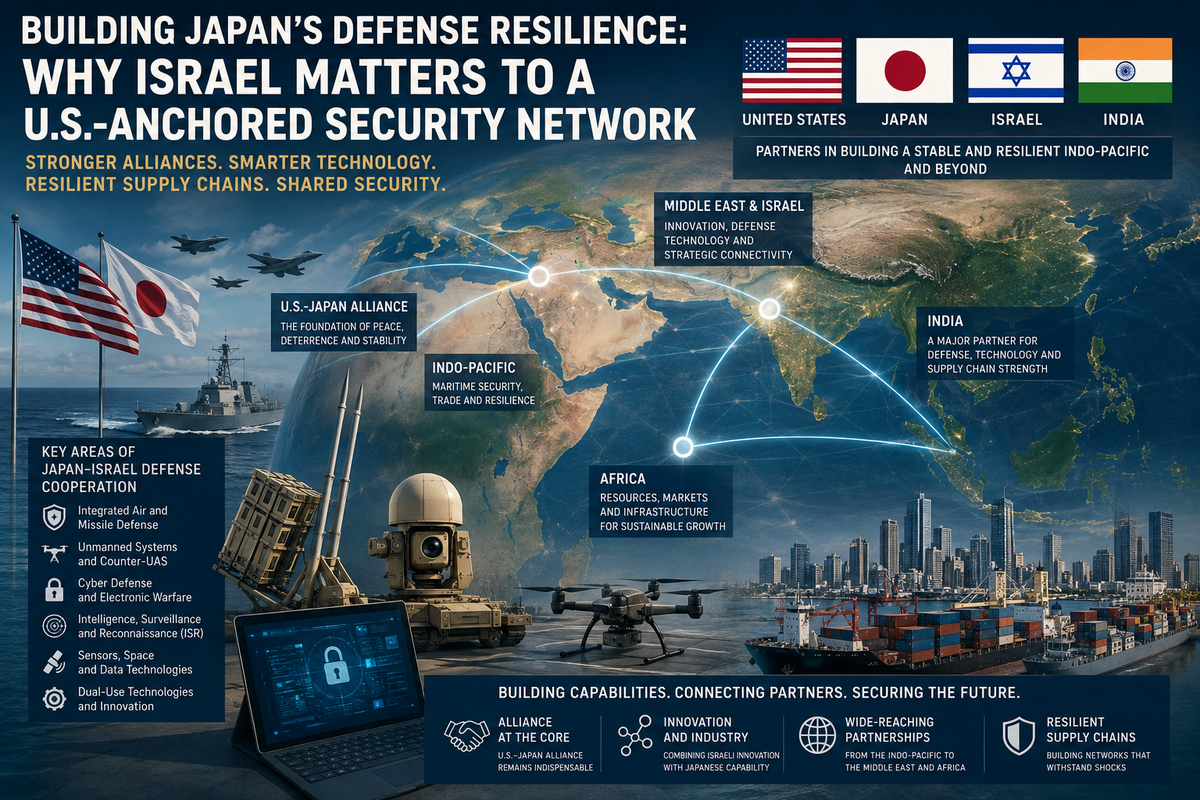
Building Japan’s Defense Resilience: Why Israel Matters to a U.S.-Anchored Security Network
Japan’s security rests on the U.S. alliance, but resilience requires more. Israeli defense innovation, Japanese industrial strength, and U.S. interoperability can help build a security network spanning the Indo-Pacific, Middle East, and Africa.
By Hannah Klein
Japan does not need to choose between the United States and new strategic partners. It needs to build more connections among them.
That distinction should become central to Japan’s security strategy.
The U.S.–Japan alliance remains the indispensable foundation of Japan’s defense. Nothing in the emerging security environment diminishes that reality. If anything, growing military pressure around Japan, intensifying China–Russia cooperation, the possibility of a Taiwan Strait contingency, and the proliferation of missiles, unmanned systems and cyber capabilities make the alliance more important.
But an alliance, however strong, does not by itself constitute a complete defense ecosystem.
Japan must now build the industrial, technological, logistical and diplomatic networks that allow the alliance—and Japan’s own defense capabilities—to function under sustained pressure. That means strengthening the connections between the United States and Japan while building outward toward India, the wider Indo-Pacific, the Middle East, Israel and ultimately Africa.
Within that architecture, Israel deserves considerably more attention.
Israel should not be viewed as an alternative to the United States. Nor should closer Japan–Israel defense cooperation be conceived primarily as a new market for imported weapons. Its strategic value lies elsewhere: Israel possesses experience and technology in precisely several of the areas that are becoming increasingly important to Japan—integrated air and missile defense, unmanned systems, intelligence, surveillance and reconnaissance, electronic warfare, cyber defense, sensors and rapid defense innovation.
The strategic question, therefore, is not whether Japan should “buy Israeli.”
It is whether Japan can combine Israeli innovation, Japanese industrial capacity and U.S.-anchored interoperability to build a more resilient defense ecosystem.
That is a much larger proposition.
Japan’s Problem Is No Longer Simply How Much Defense Equipment It Possesses
Japan’s security environment has changed faster than the institutional assumptions that shaped much of its postwar defense posture.
Tokyo’s own assessments are explicit. Japan’s 2025 Defense White Paper described China’s external posture and military activities as an “unprecedented and the greatest strategic challenge” to which Japan must respond through its comprehensive national power and cooperation with allies and like-minded countries. It also highlighted increasing Chinese activity around Taiwan, the East China Sea and the wider Western Pacific.
Russia presents a different but connected problem.
Japan’s Ministry of Defense has documented continued Russian military activity around Japan alongside deepening strategic and military cooperation between Moscow and Beijing, including joint bomber flights and naval activities. Tokyo assesses repeated China–Russia joint activities around Japan as a serious security concern.
This does not establish that Beijing and Moscow share a specific joint plan to dominate Japan’s supply chains. Such a claim would require evidence that is not presently available in the public record.
What the evidence does establish is strategically significant enough: Japan must plan for an environment in which Chinese and Russian military power can generate pressure from different directions while the United States simultaneously carries global commitments.
The resulting challenge is not simply one of platforms.
Japan can purchase more missiles, ships and aircraft, but modern conflict tests the entire system behind those platforms.
Can sensors detect a large number of simultaneous threats?
Can command networks distinguish between drones, cruise missiles and ballistic missiles quickly enough?
Can commanders allocate expensive interceptors efficiently?
Can ports, airfields, communications networks, energy systems and data infrastructure continue functioning under physical and cyber attack?
Can damaged equipment be repaired quickly?
Can industry continue producing components and munitions after months rather than days of crisis?
Can Japan obtain critical materials when commercial shipping routes are disrupted?
These questions move defense policy into the realm of industrial resilience.
Japan’s National Defense Strategy already points in this direction. Its priority capabilities include stand-off defense, integrated air and missile defense, unmanned assets, cross-domain operations, command-and-control and intelligence functions, mobility and civil protection, and sustainability and resilience.
The next step is to build the international industrial architecture capable of supporting those capabilities.
The United States Must Remain at the Center
Any serious discussion of Japan’s future defense architecture must begin with the United States.
In May 2026, Japanese and U.S. defense leaders agreed to accelerate concrete security cooperation to strengthen the deterrence and response capabilities of the alliance. Washington also welcomed Japan’s efforts to strengthen its own defense capabilities and its evolving framework for defense equipment and technology transfer.
More importantly, Japan–U.S. cooperation is moving beyond the traditional buyer–supplier relationship.
The Defense Industrial Cooperation, Acquisition, and Sustainment framework—DICAS 2.0—is addressing ship maintenance, fighter-engine components, critical goods and materials, supply-chain resilience and small unmanned aerial systems. Japanese companies are becoming more directly connected to the sustainment of U.S. forces, while both governments are examining how industrial capacity can support shared deterrence.
This provides the correct foundation for thinking about Israel.
Japan should not construct parallel technological systems that undermine interoperability with the United States. It should identify areas where Israeli capabilities can complement Japanese requirements within an alliance-centered architecture.
In other words, the strategic formula should be:
Israeli innovation × Japanese manufacturing × U.S. interoperability.
Each component contributes something different.
The United States provides the alliance framework, extended deterrence, enormous military-industrial capacity, operational integration and the central security relationship upon which Japan relies.
Japan brings sophisticated manufacturing, materials science, electronics, precision engineering, shipbuilding and an increasingly important capacity to sustain U.S. forces in the Western Pacific.
Israel brings a defense innovation ecosystem shaped by urgent operational requirements, rapid development cycles and substantial experience in areas including missile defense, unmanned systems, sensors, cyber security and electronic warfare.
Connecting these strengths would not weaken the U.S.–Japan alliance.
Properly designed, it could reinforce it.
Why Israel Matters
Japan and Israel are not starting from zero.
In 2019, the two governments signed a memorandum concerning the protection of classified information exchanged in relation to defense equipment and technology. In 2022, their defense ministers signed a revised Memorandum on Defense Exchanges and affirmed their intention to strengthen cooperation including defense equipment and technology.
Political-military dialogue has continued. The fifth Japan–Israel Pol-Mil Dialogue was held in Tokyo in January 2026, involving Japan’s Ministry of Foreign Affairs, Ministry of Defense and National Security Secretariat and their Israeli counterparts. The two sides discussed both the Middle East and Indo-Pacific security environments.
Economic and innovation ties provide another layer. Japan and Israel have an investment agreement in force, and the Japan–Israel Innovation Network has provided a government-supported framework for innovation cooperation. In September 2025, Japanese and Israeli officials again discussed collaboration through that network.
The institutional pieces therefore exist.
What is needed is to build greater strategic depth between them.
Israel’s relevance to Japan is particularly clear when viewed through Japan’s own stated capability priorities.
Integrated air and missile defense is one example. Japan faces a complex spectrum of potential aerial threats, from ballistic and cruise missiles to increasingly capable unmanned systems. Israel has spent decades developing layered approaches to aerial defense under persistent operational pressure.
The lesson for Japan is not that an Israeli system can simply be transplanted onto the Japanese archipelago. Geography, threat profiles, command structures and alliance requirements are different.
The more valuable question is what Japan can learn or jointly develop in areas such as sensors, interception economics, command-and-control integration and counter-unmanned-aircraft technologies.
Unmanned systems represent another obvious field.
The war in Ukraine and conflicts in the Middle East have demonstrated that inexpensive drones can impose disproportionate costs on militaries that depend exclusively on expensive interception methods. Japan must therefore think not only about acquiring unmanned platforms but also about detecting, classifying, jamming and defeating them at scale.
Japan and the United States are already treating small unmanned aerial systems as a supply-chain cooperation issue under DICAS 2.0.
That creates a logical opening for carefully selected Israeli technologies and expertise to contribute to a broader allied ecosystem—provided interoperability, information security, export controls and Japanese operational requirements are addressed from the beginning.
Cyber defense, electronic warfare and ISR present similar opportunities.
But the objective should never be technology acquisition for its own sake.
Japan needs capabilities that remain operational during prolonged crisis.
From Procurement to Co-Production
This leads to the most important industrial principle.
Japan should avoid replacing one external dependency with another.
Simply purchasing more foreign defense equipment may close immediate capability gaps, but it does not necessarily build national resilience. If maintenance, software updates, replacement components, specialized materials or munitions remain available only from overseas, the vulnerability has merely changed location.
The better model is selective co-development and co-production.
Where legally, commercially and strategically feasible, Japan should seek arrangements that create domestic capacity: joint research, Japanese production of components, licensed manufacturing, maintenance and repair capabilities, collaboration between Israeli startups and established Japanese industrial groups, and partnerships involving universities and research institutions.
This approach also fits the direction of Japan’s evolving defense-industrial policy.
Tokyo has increasingly emphasized that a strong defense industrial base is necessary not merely for economic reasons but for the ability to produce, maintain and sustain defense equipment. Japan has also revised its approach to defense equipment and technology transfers, with the government arguing that common equipment among partners can make parts and components easier to share.
This is fundamentally a supply-chain argument.
The same logic should inform Japan’s engagement with Israel.
The most strategically valuable Israeli technology for Japan may not necessarily be a complete weapons platform. It could be a sensor, an electronic subsystem, software, an interceptor component, a counter-UAS capability or a technology that Japanese industry can integrate into a larger architecture.
That would allow Japan to build capacity rather than merely purchase it.