
The Academic Blind Spot: Why Kazuo Ueda is Letting Japan’s Wealth Slip Away
Governor Kazuo Ueda's academic obsession is actively bleeding wealth out of Japan. While the BOJ targets textbook equations, the public has staged a silent mutiny—hoarding ¥100T at home. Time to abandon the ghosts of Keynes & Fisher and let the free market bring the Yen home.
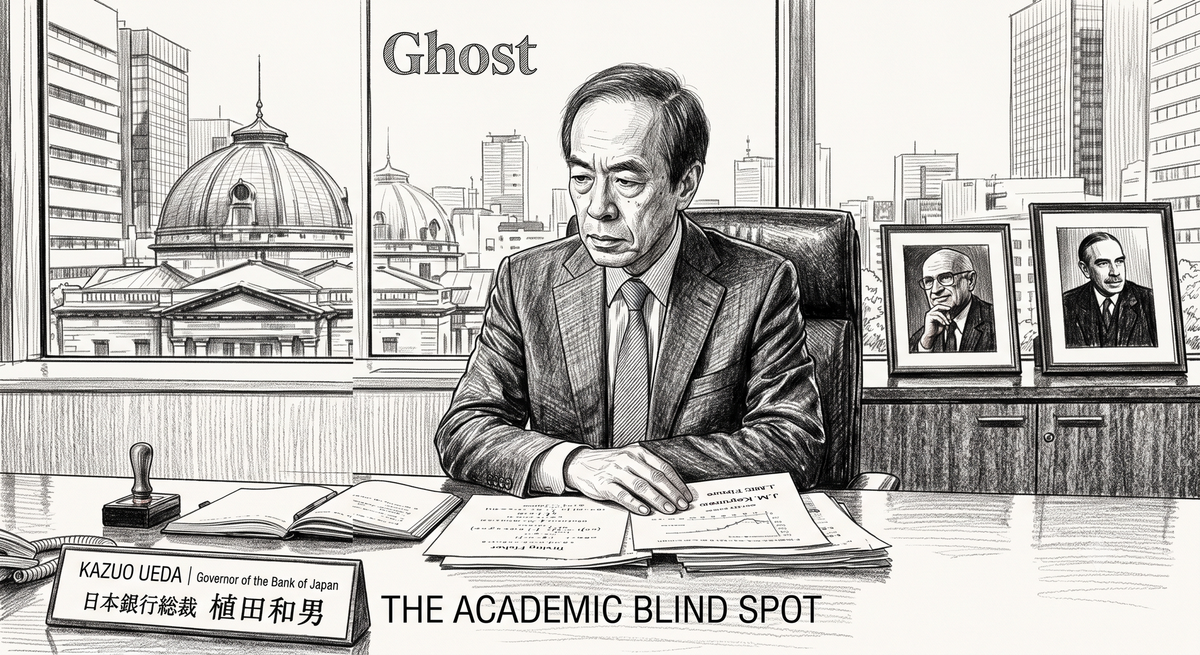
When Kazuo Ueda took the helm of the Bank of Japan, markets expected the precise, calculated touch of a world-class academic. What Japan actually got was a central banker watching global economic models while completely missing the foundational crisis right beneath his feet. The true value of the Japanese Yen isn't its exchange rate against the dollar or its utility in balancing global portfolios—it is its power to build Japan. By focusing entirely on standard textbook mechanics and state intervention, the BOJ fails to grasp a painful reality: a currency that does not stay home to invest in its own people, wages, and industries has surrendered its sovereignty.
If you want to understand the tragic stagnation of the Japanese economy, look no further than the intellectual rot dominating the central banking consensus. Governor Ueda operates in a fantasy world constructed by John Maynard Keynes and Irving Fisher—two men whose theories have done more to distort modern economics than any others. Fisher viewed the economy as a sterile algebraic equation, believing central planners could perfectly fine-tune a nation’s health by twisting the knobs of interest rates. Keynes went a step further, arguing that the government can print and spend its way to prosperity by artificially stimulating "demand."
Both were dead wrong, and Japan is the living proof. For thirty years, the Japanese government has intervened relentlessly, building bridges to nowhere and blowing up its debt-to-GDP ratio to absurd heights, yet completely failing to spur real domestic growth. As the great Milton Friedman brilliantly argued, the market functions best with the least amount of government intervention. Friedman knew that inflation and economic vitality are fundamentally about the stable supply of money and the freedom of the market to allocate capital organically—not the central planning of interest rates or state-mandated demand. Money is not an academic plaything for central planners; it is the organic property of the citizens.
Become a subscriber so that you are able to read this newsletter in your inbox. Also, you can be a paid subscriber today!