The Architecture of Aggression: Why Neutralizing the System Matters More Than the "Man"
As the Strait of Hormuz closes and the Nikkei faces historic trauma, the 'political framework' of the last 40 years has collapsed. From the IRGC nexus to North Korea’s next move, here is the logic behind the new era of systemic aggression—and what it means for Japan’s survival.
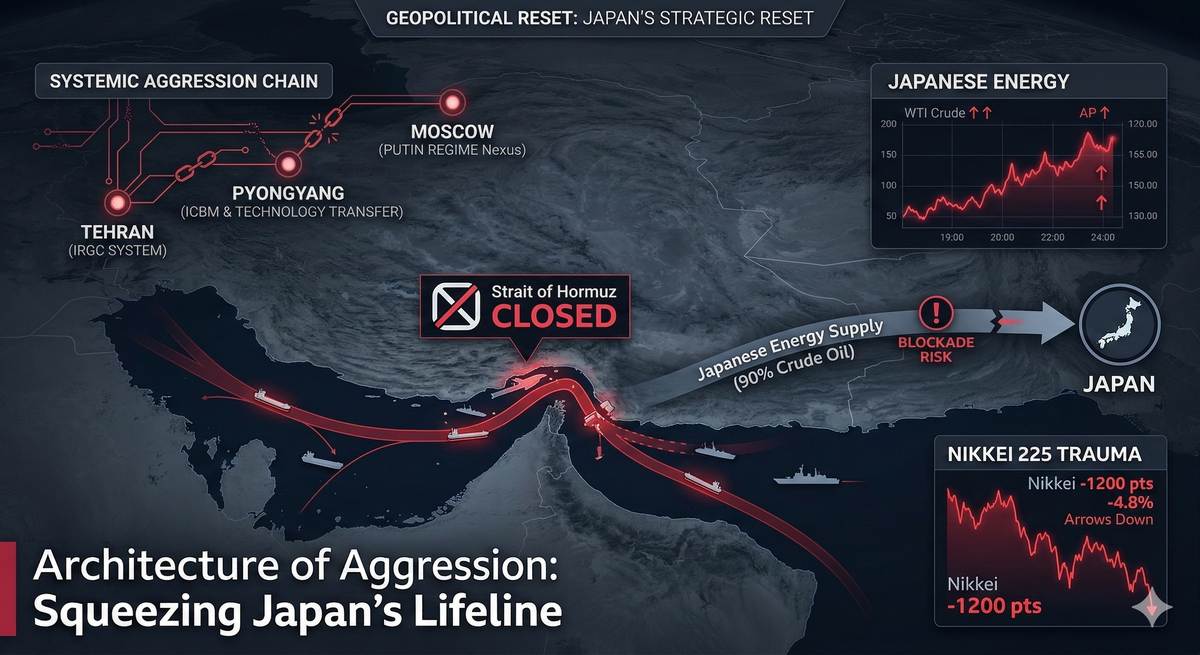
In any complex security environment, the stability of the whole is defined not by its most prominent individual, but by the energy and intent flowing through its entire network. For decades, the West has viewed the Islamic Republic of Iran through the lens of a single man: Ayatollah Ali Khamenei. However, as joint U.S.-Israeli strikes continue to degrade Tehran’s command infrastructure this March, we must realize that a "decapitation strike" is merely a tactical opening. The true threat to global security is systemic aggression—an institutionalized machinery of IRGC-led destabilization that will attempt to regenerate even as its head is removed.
As a Japanese citizen, I do not personally endorse war as a first resort; my culture and my personal faith lean deeply toward the preservation of peace and the sanctity of life. However, one cannot be a serious geopolitical analyst without acknowledging that the Islamic Republic of Iran has evolved into a threat that is no longer "regional," but imminent and global. For the United States, any decision to engage in such a high-stakes conflict must be rooted firmly in the interests and security of the American people. This is not a theoretical debate for me. I have individuals within my own circle who are active service members, and witnessing this escalation is a moment of profound fear and gravity. When we discuss the "interest of the nation," we are ultimately discussing the lives of these individuals. Their sacrifice demands that we move past the failed academic frameworks of the past and look clearly at the reality of the threat we face today.
The disaster we are witnessing in 2026 is the direct result of a total failure in the "political framework" that has defined Western diplomacy toward Tehran for nearly fifty years. Since the return of Ayatollah Khomeini in 1979, there has been a persistent, almost dogmatic belief in certain sectors of U.S. academia and policy circles that the Islamic Republic could be tamed through standard diplomatic engagement and economic incentives. This perspective treated a revolutionary theological regime as if it were a typical state actor seeking a seat at the global table.
In reality, this framework only provided the regime with the time and resources necessary to accelerate its regional and nuclear ambitions—enriching uranium at a pace far beyond what was seen during the Obama administration. I am not asking the Israeli people to endorse any specific political party, nor am I advocating for conflict; I pray daily for the peace and stability of the region. However, we must be honest: the U.S. failure to recognize the regime's true nature has led to this critical instability. When the Supreme Leader targets Israel using terms like "the Zionist regime," it is not mere social media rhetoric or a "joke." It is a stated mission of a system that has spent decades preparing for this very confrontation, while the West remained committed to a framework that never truly existed.
While the international community often debates this conflict through the lens of moral justice, for Japan, the stakes are matter-of-fact and existential. We must look at the Middle East not as a distant theater of war, but as the literal engine of our national economy. With the effective closure of the Strait of Hormuz this March—a waterway through which over 70% of our crude oil imports pass—Japan is facing a direct threat to its industrial stability. I do not view this as a "war of justice" in the abstract; rather, I see it as a necessary, albeit painful, process of stabilizing a region that has been held hostage by systemic aggression for too long. Japan's future development, particularly our growing economic and technological partnerships with Middle Eastern nations like Israel, depends on a region that is no longer subject to the whims of a regime that uses energy chokepoints as a tool of extortion. Although the current volatility is a difficult test for our markets and our people, the long-term stabilization of these energy supply chains is the only way to secure Japan’s economic sovereignty and its role as a leader in the global market.
The severity of this situation is reflected in the immediate and "rough" volatility of the Japanese markets. Following the escalation of the conflict and the effective blockade of the Strait of Hormuz, the Nikkei 225 has faced significant pressure, dropping sharply as investors react to the potential for a prolonged energy shock. Just this morning, the index saw a dramatic swing, losing over 2,000 points at its low as the reality of a 30% jump in gas prices began to settle in.
While there have been temporary rebounds driven by hopes of a quick resolution, the underlying sentiment remains one of deep caution. This "market trauma" is not merely a reaction to headlines; it is a mathematical adjustment to the fact that Japan’s trade balance and inflation targets are now at the mercy of a region in turmoil. When the Yen weakens to the 157-158 range and shipping stocks are the only ones finding a bid, it serves as a stark warning: the "political framework" that promised stability has collapsed, and the Japanese economy is now paying the "uncertainty tax" for decades of diplomatic miscalculation.
It is important to clarify that my critique is not an attack on the value of academic frameworks themselves, which serve a vital role in understanding international relations. However, in the specific case of the Islamic Republic, there has been a significant and dangerous gap between academic theory and the harsh reality on the ground. For years, a dominant school of thought in U.S. foreign policy circles argued that the Iranian regime could be "contained" or even "transformed" through a series of structured diplomatic agreements. This belief held that by offering economic pathways, the West could incentivize the regime to moderate its behavior. In reality, the story was quite different.
Far from being "controlled" by these political frameworks, the regime utilized the diplomatic breathing room to fasten its grip on the region and, most critically, to accelerate its nuclear program. We have seen uranium enrichment reach levels that far exceed anything witnessed during previous administrations, moving toward the 60% and even 90% thresholds that have no credible civilian purpose. This was not a failure of diplomacy in the abstract, but a failure to recognize that the Islamic Republic viewed these "frameworks" not as a bridge to peace, but as a shield behind which it could pursue its ultimate goal of nuclear breakout.
Ultimately, any decision to enter a state of war must be rooted in the genuine interest of the American people, not merely the preferences of insulated political or academic "circles." When foreign policy is dictated by a narrow elite while the broader public remains uninformed or misled by outdated theories, the result is a systemic corruption of the national interest. As a Japanese observer with cherished friends who are active U.S. service members, I see this not as an abstract debate, but as a matter of life and death.
It is a fearful and critical moment for those with loved ones on the front lines, and they deserve a strategy as clear and honest as their own commitment to duty. We must move away from the "shadow diplomacy" and profit-oriented motives that have characterized the last few decades. The American people, and the service members who bear the actual burden of these decisions, deserve to know that their sacrifice is not being spent on a "framework" that has already failed, but on a decisive action to secure a truly stable future for their country and the world.
While the world’s attention is rightfully fixed on the "Epic Fury" operations in the Middle East, we must not ignore how this chaos serves as a laboratory for the dictatorships of the Pacific. My forecast is that China, under Xi Jinping, will not seek a direct military breakout during this disaster; instead, Beijing will surgically pursue whatever benefits its regional economic dominance. Xi’s domestic support remains tied to his ability to sustain the development he has overseen since becoming the head of the CCP, and he is unlikely to risk that stability for a secondary war. However, the same cannot be said for North Korea. As a nation now heavily involved in the war in Ukraine and expanding its influence across the Global South and African nations, Pyongyang has become a high-velocity variable. Unlike the calculated, market-conscious leadership in Beijing, the Kim regime thrives on the very "systematic aggression" that characterized the Islamic Republic. With the U.S. and its allies preoccupied with the fallout of the Iran-Israel war, North Korea may see a unique window to test the resolve of the West, transforming from a regional nuisance into an imminent global trigger.
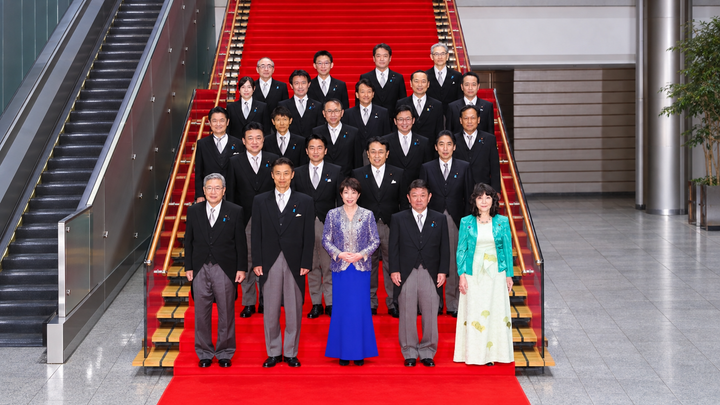
In moving toward a reset of global security, we must distinguish between constructive de-escalation and the kind of passive appeasement that has historically invited aggression. For Japan, this is no longer a theoretical debate; under the current Takaichi administration, we are seeing a necessary and significant increase in the defense budget to 2% of GDP—a move driven by the realization that we must secure our own regional interests.
This "Takaichi Doctrine" represents a clean break from the past, focusing on a proactive defense that includes direct dialogue with Beijing to manage tensions. However, the most urgent variable in this security reset is the destabilizing role of the Putin regime. By providing advanced missile technology to North Korea as a reward for its involvement in the Russia-Ukraine War, Moscow has effectively merged the European and Pacific theaters of conflict. To truly secure the Indo-Pacific, we must acknowledge that neutralizing the threat from the Islamic Republic is only one part of the equation; we must also address the dangerous technology transfers between Russia and Pyongyang that threaten to turn North Korea into a permanent, nuclear-armed trigger in our own backyard.
We are undeniably entering an era defined by systemic chaos, where the boundaries of global security are being redrawn by force. Yet, as we navigate this transition, we must never lose sight of the foundational importance of democracy in both our domestic politics and our foreign policies. In this landscape of geopolitical risk, Japan is now required to build and strengthen multifaceted bilateral and multilateral relationships—leveraging the Japan-U.S. alliance as a cornerstone while deepening strategic partnerships with India, the ROK, and like-minded nations in the Global South.
These alliances are essential not only for security but for stabilizing the global markets and recovering our devastated economies from the long shadows of the COVID-19 pandemic and the current wars. As a Japanese citizen, I believe it is essential to remember that war, while sometimes a necessary choice to prevent a larger catastrophe, is ultimately a destructive behavior and a choice of last resort. By neutralizing systemic threats and securing our supply chains through robust international cooperation, we are seeking to restore a world where democratic dialogue and economic partnership can once again be the primary engines of human progress. In this difficult time, our commitment to a rule-based order is the only path toward ensuring that the coming era of chaos eventually gives way to a lasting and meaningful peace.
Comments ()