
The Cannibal State: From the St. Petersburg Fixer to the Cuban Front
From 90s St. Petersburg to 2026 Ukraine, the FSB is a global engine of extraction. As 24,000 Cubans face a 140-day survival rate for Russian fuel, PM Sanae Takaichi signals a break from the "Axis of Disruption." This 20-year analysis dissects the "Blood for Fuel" trade and the Takaichi Doctrine.
The Stolen Dream of 1991
I have never been convinced that the 1991 collapse of the Soviet Union truly led to the democratization of Russia. While the Russian people are a nation that has long wished for freedom—a deep-seated hope I have traced for over two decades—that aspiration was systematically outmaneuvered during the grim transition following Gorbachev’s fall. The hope of 1991 was not lost to chance; it was intercepted by the FSB, an entity that chose to side not with the people, but with a "cleaner." Vladimir Putin’s career did not begin with a vision for a new Russia, but with a specialized talent for covering up the corruption of his former university professor and patron, St. Petersburg Mayor Anatoly Sobchak. I have listened to the steady flow of Russian politics for twenty years, and it is clear: the man who once orchestrated a daring "medical evacuation" to Paris to save his boss from a criminal investigation is the same man who has turned the entire Russian state into a private, KGB-style protection racket.
The Cheka Inheritance and the St. Petersburg Pact
To understand why the dream of 1991 was stolen, one must look at the true nature of the FSB. It is not a domestic security service in the Western sense, such as the UK’s historical MI15—which operated within a strict military and aerial intelligence hierarchy—but rather the direct ideological descendant of the Cheka, the Bolshevik secret police. The FSB operates on the cult of "Chekism," a belief that they are a "New Nobility" standing above the law to preserve the state at any cost. In the chaotic 1990s, the FSB was an institution in crisis—humiliated and searching for a way to monetize its "special skills." They found their savior in Putin. In 1992, investigator Marina Salye proved that Putin had signed off on a $124 million "Food for Raw Materials" deal where Russia’s minerals were exported, but the food for the starving citizens never arrived. Sobchak protected his fixer, and the FSB watched as Putin perfected the art of making the illegal appear legal.
The 1996 "Final Exam" and the 2026 Takaichi Doctrine
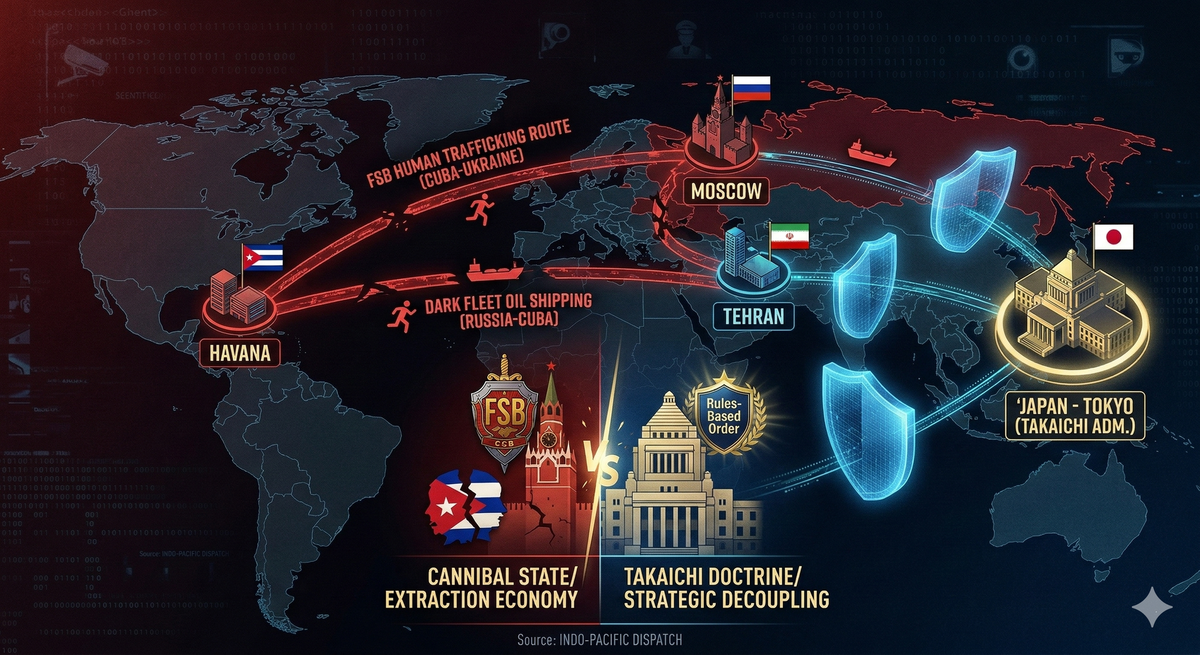
The definitive "Pact" between the FSB and Putin was sealed by his absolute loyalty to his patrons over the rule of law. In 1996, after Mayor Sobchak faced arrest for corruption, it was Putin who orchestrated his escape to Paris. This act of cold-blooded loyalty was Putin's "final exam" for the FSB and the "Yeltsin Family" in Moscow. Fast forward to March 2, 2026: the world is finally witnessing a counter-offensive against this "Chekist" rot. In a historic session of the House of Representatives Budget Committee, Japanese Prime Minister Sanae Takaichi delivered a definitive blow to this axis. Breaking from decades of cautious diplomacy, she declared that Iran’s nuclear weapons development "cannot be tolerated at all." This was not just a comment on the Middle East; it was a strategic strike against the Russia-Iran-Cuba network that the FSB uses as its global "war engine." By leading the charge for a "Rules-Based Order" and tightening maritime intelligence against "Dark Fleet" tankers, the Takaichi administration is effectively starving the FSB’s ability to "clean" its illicit transactions through international channels.
The Diplomatic Faustian Bargain: Moscow’s Caribbean Lifeline
Diplomatically, the relationship between Russia and Cuba in 2026 has devolved into a mutual survival pact. Following the U.S.-led removal of the Maduro regime in Venezuela in January, Havana lost its primary source of subsidized oil, plunging the island into a terminal energy crisis with 16-hour daily blackouts. In February 2026, Russian officials finalized what they termed "humanitarian energy aid." But this diplomacy is a thin veil for a predatory exchange. While the Kremlin publicly condemns the "suffocating" U.S. blockade, it is privately using Cuba’s desperation to secure the one thing the FSB-led war effort lacks: manpower. This is the globalized version of the 1992 St. Petersburg "minerals-for-food" scandal.
Blood for Fuel: The 140-Day Sentence
The most harrowing evidence of this "cannibal state" is the recruitment of Cuban youth. Intelligence reports indicate that up to 25,000 Cubans have been funneled into the Russian military machine—the largest Cuban foreign intervention in decades. Lured by false promises of "construction jobs" in Moscow and salaries they cannot fathom in Havana, these men are signed into contracts in a language they do not understand. With barely two weeks of training, they are deployed to the most dangerous sections of the front. The reality is a death sentence: the average survival rate for a Cuban recruit in the trenches is now a mere 140 days. The same FSB that once "cleaned" the scandals of a corrupt professor is now "cleaning" the lives of Cuban youth, trading humanity for the energy required to sustain a failing tyranny.
The Verdict: No Cuba Without Russia
Ultimately, the lesson of the last two decades is one of strategic and moral clarity: it is impossible to discuss the future of Cuba without confronting the reality of Russia, and it is impossible to discuss Russia without the explicit, unequivocal condemnation of Vladimir Putin and his FSB-led machinery. As Prime Minister Takaichi signaled this month, the "Axis of Disruption" is a single, interconnected organism. For U.S. and Allied defense policy, the path is now clear: there is no stable Caribbean as long as the FSB's "war engine" remains operational. By dismantling the Kremlin’s global reach, we are finally severing the leash on Havana. The liberation of both Russia and Cuba is a singular goal. The era of the "cleaner" is ending, and as the shadow lifts, we must ensure that the "Chekist" blueprint is never drawn again.


Comments ()